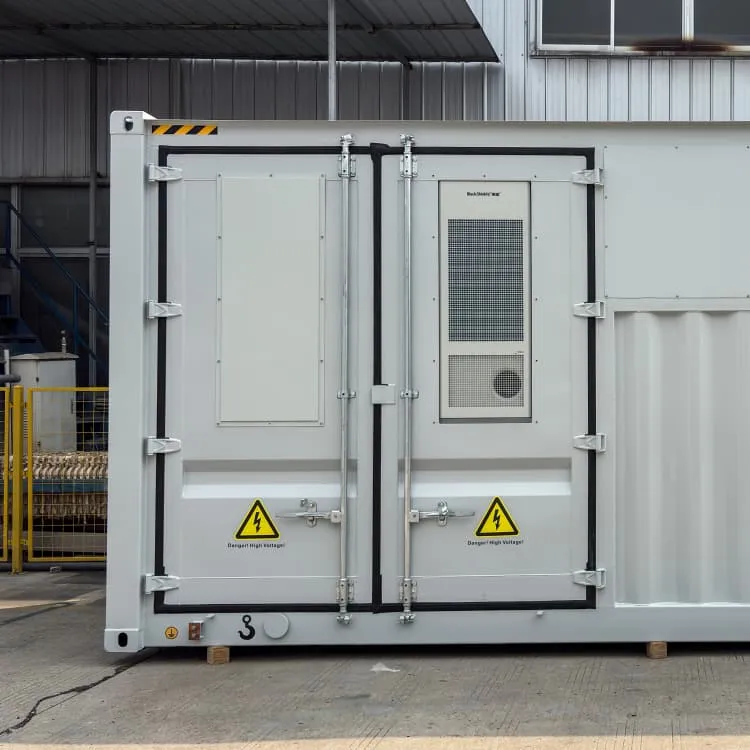
Any must match electricity production to consumption, both of which vary significantly over time. Energy derived from and varies with the weather on time scales ranging from less than a second to weeks or longer. is less flexible than , meaning it cannot easily match the variations in demand. Thus, without storage presents special challenges to .
[PDF Version]
This article analyzes the key strategies for safety management of energy storage power stations throughout their life cycle based on international standards (such as NFPA 855, IEC 62933) and industry best practices. Ⅰ. Risk identification: three major. .
This article analyzes the key strategies for safety management of energy storage power stations throughout their life cycle based on international standards (such as NFPA 855, IEC 62933) and industry best practices. Ⅰ. Risk identification: three major. .
Risk identification: three major safety hazards of energy storage power stations Ⅱ. Safety design: Build a protection system from the source Ⅲ. Operation management: full life cycle protection strategy Ⅳ. Emergency response: What to do when an accident occurs? V. Future trend: Technological. .
The International Renewable Energy Agency predicts that with current national policies, targets and energy plans, global renewable energy shares are expected to reach 36% and 3400 GWh of stationary energy storage by 2050. However, IRENA Energy Transformation Scenario forecasts that these targets. .
The DCFlex initiative is a pioneering effort to demonstrate how data centers can play a vital role in supporting and stabilizing the electric grid while enhancing interconnection efficiency. It aims to drive a cultural, taxonomic, and operational transformation across the data center ecosystem.
[PDF Version]

Record renewables growth led by solar helped push clean power past 40% of global electricity in 2024, but heatwave-related demand spikes led to a small increase in fossil generation..
Record renewables growth led by solar helped push clean power past 40% of global electricity in 2024, but heatwave-related demand spikes led to a small increase in fossil generation..
Record renewables growth led by solar helped push clean power past 40% of global electricity in 2024, but heatwave-related demand spikes led to a small increase in fossil generation. Ember’s sixth annual Global Electricity Review provides the first comprehensive overview of changes in global. .
This article was written by Nelson Nsitem, Senior Associate, Energy Storage, and Yayoi Sekine, Head of Energy Storage, BloombergNEF. It appeared first on the Bloomberg Terminal. The global energy storage market is poised to hit new heights yet again in 2025. Despite policy changes and uncertainty. .
Our Annual Global Energy Storage market report adds to our continued series of key energy transition focused industry reports. The collective works are the result of a valued research collaboration between ourselves and Alchemy Research and Analytics, a leading industry research group working.
[PDF Version]
Electricity can be stored directly for a short time in capacitors, somewhat longer electrochemically in , and much longer chemically (e.g. hydrogen), mechanically (e.g. pumped hydropower) or as heat. The first pumped hydroelectricity was constructed at the end of the 19th century around in Italy, Austria, and Switzerland. The technique rapidly expanded during the 196.
[PDF Version]
in has developed from small-scale research programs of the 1970s into a key component of the nation’s renewable energy strategy. South Korea has expanded generation with tools and initiatives such as legal frameworks, feed-in tariffs, national basic energy plans, and municipal programs. Installed photovoltaic capacity grew rapidly in the 2000s and 2010s, but despite years of progress, the nation’s solar sector faces challenges suc.
[PDF Version]
A perovskite solar cell (PSC) is a type of that includes a compound, most commonly a hybrid organic–inorganic or as the light-harvesting active layer. Perovskite materials, such as the all-inorganic cesium lead halide, are cheap to produce and simple to manufacture.
[PDF Version]